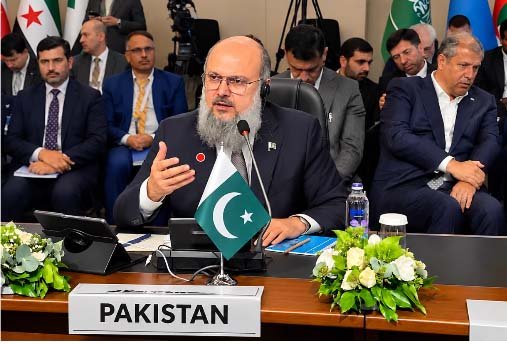
ISTANBUL:Federal Minister for Commerce Jam Kamal Khan has called for stronger economic solidarity, improved access to trade financing and coordinated efforts to enhance intra-OIC trade while addressing the closing session of the 42nd Ministerial Session of the Standing Committee for Economic and Commercial Cooperation (COMCEC) in Istanbul, while speaking on behalf of the member states of the Organization of Islamic Cooperation (OIC).
Addressing the high-level gathering chaired by Vice-President of the Republic of Türkiye, Cevdet Yilmaz, and the Commerce Minister emphasized those growing geopolitical tensions, supply chain disruptions, financial vulnerabilities and increasing protectionism had made economic cooperation and collective action among Islamic countries more important than ever, said a release issued here on Friday.
Speaking on behalf of OIC member states, Jam Kamal Khan expressed appreciation to the Government and people of Türkiye for their warm hospitality and excellent arrangements. He also acknowledged the contributions of the COMCEC Coordination Office and OIC institutions towards the successful conduct of the session.
The Minister said that OIC countries possessed significant economic potential, geographical advantages, human resources and natural endowments that could be transformed into shared prosperity through stronger partnerships and coordinated policies.
He observed that while OIC member states had made considerable progress in sustainable development, technological advancement and economic prosperity over the decades, emerging global challenges required them to work together and develop practical solutions suited to their circumstances.
Highlighting the outcomes of the session, Jam Kamal Khan said the deliberations had identified important areas for collective action, including intra-OIC trade, transport connectivity, sustainable tourism, agricultural productivity, food security, poverty alleviation and digital transformation.
Referring to the session’s priority theme, “Developing Effective Trade Financing Tools for Increasing Exports in the OIC Member Countries,” the Minister stressed that affordable, diversified and sustainable trade financing was essential for improving export competitiveness, expanding international trade and accelerating economic growth.
He pointed out that exporters, particularly micro, small and medium-sized enterprises (MSMEs), continued to face difficulties in accessing suitable financing due to fragmented regulatory frameworks, high collateral requirements, transaction costs and lengthy administrative procedures.
To address these challenges, the Commerce Minister outlined five priority areas requiring closer cooperation among OIC member states.
He emphasized the need to strengthen and harmonize national legal, regulatory and supervisory frameworks to facilitate cross-border transactions and improve access to trade financing.
He also called for diversification of trade financing instruments, stronger export credit guarantee mechanisms and innovative financial arrangements tailored to the requirements of exporters, particularly MSMEs and technology-driven enterprises.
Highlighting the potential of Islamic finance, Jam Kamal Khan urged member states to promote Shariah-compliant trade financing through enhanced institutional capacity, risk-sharing arrangements, Islamic export credit insurance and closer cooperation among Islamic financial institutions.
The Minister further stressed the importance of accelerating digital transformation in trade and financial processes through the integration of customs and banking systems, electronic trade documentation and single-window platforms.
He said these measures could significantly reduce transaction costs, simplify procedures and improve the efficiency of cross-border trade.
Jam Kamal Khan also underscored the importance of improving access to financing for MSMEs, particularly women- and youth-led enterprises, through targeted financing facilities, credit guarantees, financial literacy programmes, technical assistance and stronger market linkages.
He maintained that implementing these measures in accordance with the national legal and regulatory frameworks of member states could substantially strengthen export capacity and promote intra-OIC trade.
The Minister called upon COMCEC to continue supporting member states in translating policy recommendations into practical and measurable outcomes through its project support mechanisms, analytical work and institutional cooperation.Emphasizing the broader economic cooperation agenda, Jam Kamal Khan described the private sector as a central partner in promoting investment, innovation, industrial development and employment.
He encouraged greater interaction among business communities across OIC countries to unlock new opportunities for trade, investment and joint economic initiatives.
On agriculture and food security, the Minister called for enhanced cooperation in agricultural research, technology transfer, resilient food systems and investment in sustainable agricultural value chains to address emerging challenges and strengthen long-term food security.Addressing the situation in Palestine on behalf of OIC member states, Jam Kamal Khan reaffirmed unwavering support for the Palestinian people’s legitimate struggle for their inalienable right to self-determination.
He expressed grave concern over continued Israeli aggression and the immense humanitarian suffering in Gaza, as well as actions undermining the historical and legal status of Jerusalem, violations of the sanctity of Muslim and Christian holy sites and the expansion of illegal settlements.
Concluding his address, Jam Kamal Khan stressed that the success of the 42nd COMCEC Session would ultimately be measured by the effective implementation of its decisions rather than the adoption of recommendations alone.
He urged OIC member states to maintain close coordination, deepen partnerships and pursue practical initiatives that would translate collective commitments into tangible economic and developmental benefits for their peoples.
The Commerce Minister expressed hope that the forthcoming 43rd Session of COMCEC would build upon the progress achieved and further advance the shared economic and development objectives of OIC member states.