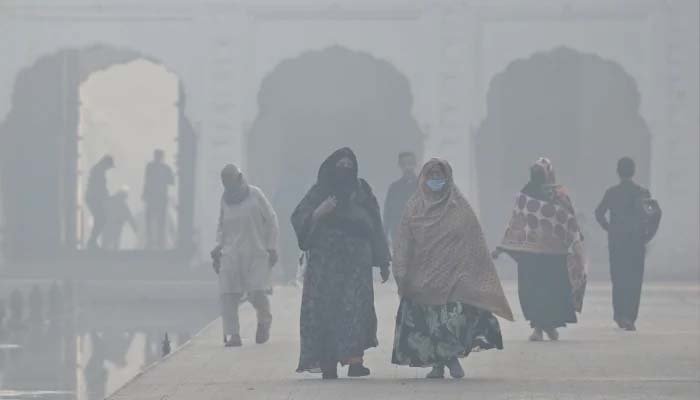
Lahore has once again topped the list of the world’s most polluted major cities, recording a particulate matter reading of 538 between 9am and 10am on Sunday, according to the figures from the Swiss air quality monitoring platform IQAir.
The Swiss air quality platform categorises readings above 300 as “hazardous”, indicating extremely polluted air that poses serious health risks to residents.
India’s Delhi ranked second among the world’s major cities, with a particulate matter reading of 207.
Bahawalpur in Pakistan’s Punjab reported a high reading of 463, while Sargodha recorded 382.
Multan registered a particulate matter reading of 255, according to IQAir.
The toxic haze has left Punjab’s capital city shrouded for days, reducing visibility and causing widespread health complaints, including throat irritation, breathing difficulties and itchy eyes.
Over recent years, Pakistan and India have each accused the other of worsening the air.
Earlier this month, Punjab Senior Minister Marriyum Aurangzeb linked the worsening smog across the province to large-scale fireworks during Diwali celebrations in India.
In a post on X, she said that polluted winds entering through the eastern corridor from Indian cities contributed to the increase in the provincial capital’s AQI.
Silwat Saeed, chief of the Environment Protection and Climate Change Department in Punjab, previously said that the challenge was huge for both countries and that Pakistan has raised it with officials from India at international forums.
Every winter, much of South Asia experiences a surge in pollution as cold air traps fine particles near the surface. Emissions from transport, factories, construction dust and crop residue burning all contribute to the dense smog that lingers for weeks.
Health experts warn that prolonged exposure to such high pollution levels can lead to severe health issues, including stroke, heart disease, lung cancer and chronic respiratory illnesses — a growing concern for millions across South Asia.
Punjab minister questions IQAir data
Punjab Senior Minister Marriyum Aurangzeb, however, said that IQAir does not display updated data in real time, raising concerns over delays in pollution readings.
Addressing a press conference in Lahore, she said that data recorded at 8am continued to appear on the website until noon.
The minister said the provincial government has taken several important measures to control smog, adding that all departments across Punjab have played their role in the efforts.
Aurangzeb claimed that previous administrations had not undertaken similar levels of work to address the smog problem.
Explaining the factors affecting air quality readings, the senior minister said that low wind speeds and humidity also influenced the AQI.
She said the government has prioritised measures to improve environmental conditions across the province.
Aurangzeb added that water was being sprayed through smog guns in areas recording high AQI levels as part of efforts to control pollution.
She further said that air quality across Punjab was monitored through the AQI system, with 80 monitoring systems installed throughout the province.
The minister maintained that updated AQI data was available on the provincial government’s website.