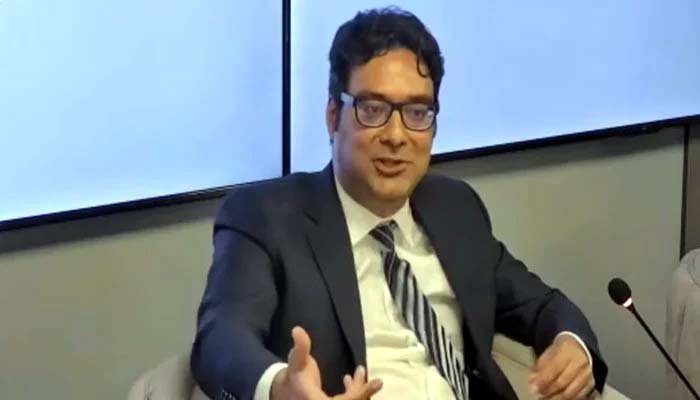
KARACHI: Prominent legal expert Barrister Salahuddin Ahmed has warned that the use of artificial intelligence (AI) in judicial rulings could lead to erroneous judgments.
Speaking to revealed that judicial decisions based on AI are emerging from district courts, describing the practice as unacceptable.
He said litigants are being compelled to approach appellate courts to challenge such rulings. He added that appellate courts should intervene and initiate action against the relevant judicial officers through the Member Inspection Team.
Barrister Ahmed recounted an instance in which a judge had used AI to draft a judicial decision. He said he appeared before the judge hearing the appeal against that decision.
He told the judge that the judgment had been written with the help of artificial intelligence.
“How can you say that?” the judge asked.
“I have thoroughly examined all the legal references and judicial precedents cited in the judgment — the very grounds on which the decision is based — but none of them actually exist,” he replied.
Barrister Ahmed further said drafting a judicial decision required consideration of all relevant legal aspects and typically took four to five hours when done by a human.
He added that although AI could complete the task in a few minutes, ensuring the accuracy of legal references and judicial precedents remained a challenge.
He stressed the need to raise awareness among legal professionals about the use of AI through seminars and workshops.
Concerns over such errors form part of a worldwide debate about the risks posed by increasingly powerful AI systems.
Jan Leike, who resigned as a senior AI safety researcher at OpenAI in 2024, said after his departure safety culture and processes had taken a “backseat to shiny products”, following disagreements with the company over its priorities.
More recently, former Anthropic researcher Jacob Coxon, who had also worked at OpenAI, resigned in September 2026 and accused leading AI companies of “gambling with our lives” as they raced to develop increasingly capable systems.
In September, a United States judge in the Oklahoma district court acknowledged using ChatGPT for legal research in a ruling that contained two fictitious case citations, according to a prosecutor’s letter reported by Reuters.