US Vice President JD Vance said on Tuesday that the US does not always agree with Israel, stressing that Washington cannot allow its Middle East foreign policy to be “subservient to the state of Israel.”
Speaking on the All-In Podcast on YouTube, Vance said that President Donald Trump acknowledged Israel’s importance as a partner in military technology and intelligence sharing, but he said Washington sometimes disagrees with Israel.
Vance said Trump, “more than, frankly, any president in the last 40 years,” has shown “a willingness to actually part ways with Bibi Netanyahu when he feels like the interests of the American people are different than the interests of the government of Israel.”
Pointing to Washington’s relationships with NATO members, Vance said the US has “a lot of important relationships, a lot of important partnerships in NATO, but that doesn’t mean we’re gonna completely make our European foreign policy subservient to NATO, in the same way that we cannot let our Middle Eastern foreign policy be subservient to the State of Israel.”
“We’re gonna work with people when we work with them; we’re gonna disagree when we disagree. And we’re gonna pursue America’s interests. That’s the only way to have a rational foreign policy,” he added.
Yemen’s armed forces confirm they shot down Saudi fighter jet
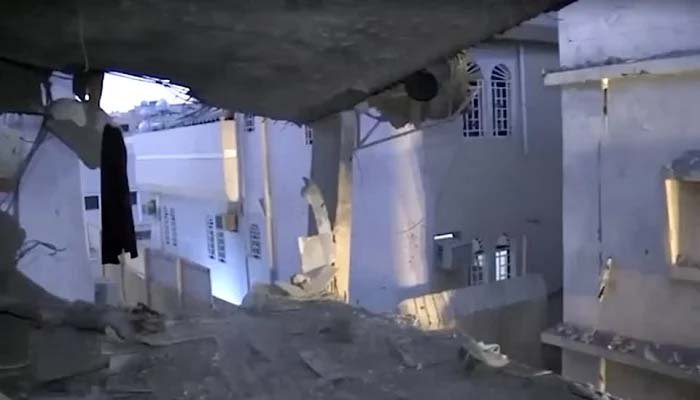
Brigadier General Yahya Saree, spokesman for the Yemeni Armed Forces, said in a statement on Wednesday that Yemeni forces downed a Saudi F-15 as the aircraft was conducting “hostile activities” over Ma’rib, according to Press TV.
According to the statement, the military aircraft was operating in support of gatherings of forces affiliated with Saudi Arabia.
The statement added that Yemeni forces also forced a Saudi F-15 and Typhoon warplanes over Ma’rib to withdraw. According to the statement, the aircraft were searching for the wreckage of the downed aircraft.
Earlier, Yemen’s Houthi rebels said they shot down a Saudi fighter jet, claiming a locally made munition was used to target the warplane, AFP reported.
“The Yemeni Armed Forces, with Allah’s aid and grace, succeeded in shooting down a Saudi F-15 fighter jet while it was carrying out hostile operations in support of its military mobilisations in the airspace of Marib province, using a locally made air-to-air missile,” a spokesman for the Houthis said on social media, while accusing Saudi Arabia of launching 450 strikes.
Houthi drone destroyed near Makkah as Saudi-led coalition warns threats to holy sites are ‘red line’
Saudi air defences intercepted and destroyed a drone said to be launched by Yemen’s Houthi group near Makkah early on Wednesday, according to the Saudi-led coalition.
Coalition spokesman Turki al-Malki said the drone was intercepted around 6:50pm local time (2050 PKT) Tuesday before entering restricted airspace, with its wreckage falling south of the city.
Al-Malki described the incident as the Houthis’ second attempt to target Mecca, citing a ballistic missile launched toward the city on July 27, 2017.
He said the security of the Two Holy Mosques and pilgrims was a “red line,” vowing that the coalition would take measures to deter further attacks.
The incident came a day after the coalition said 13 civilians were injured in missile and drone attacks by the Houthis on Khamis Mushait, Abha and Taif, with seven homes and two vehicles damaged.
OIC condemns ‘heinous attacks’ on Makkah, Madinah region
The Organisation of Islamic Cooperation condemned what it called Houthi attacks on Makkah and the Madinah region, calling them “heinous attacks” intended to “terrorise civilians” and violate the sanctity of holy sites and mosques, according to Al Jazeera.
Confrontations between Yemen’s internationally recognised government’s forces and the Houthis have escalated since early July following years of relative calm.
The country has been engulfed in war since the Houthis seized the capital Sanaa and several provinces in 2014 before a Saudi-led Arab coalition intervened in 2015 in support of the government.
Houthi rebels deny Saudi claim of drone attack on Makkah
A Houthi official rejected the Saudi-led coalition’s report that it had shot down a drone from the rebels heading towards Makkah, the holiest city in Islam. “The claims about targeting Makkah are a worn-out lie that has been used before and no longer fools anyone.
US Treasury chief says Washington waging ‘greatest economic isolation campaign’ on Iran
US Treasury Secretary Scott Bessent said on Tuesday that Washington was carrying out what he called the “greatest economic isolation campaign” against Iran and its enablers, arguing that the pressure was taking a growing toll on the Iranian economy.
“The strength of our economy has allowed the United States to wage the greatest economic isolation campaign in history against the Islamic Republic of Iran and its enablers,” Bessent said in opening remarks before the House Financial Services Committee. The committee held its annual hearing with the Treasury secretary on the state of the international financial system.
Bessent said President Donald Trump had taken action against Iran that previous administrations had deferred.
“Under his leadership, America is no longer managing the Iranian threat; we are ending it,” he said, adding that US economic strength was allowing Washington to exert pressure “from a position of strength.”
Bessent later said Iran’s economy was in “dire straits,” citing what he described as a collapse in the currency, surging inflation and long lines for gasoline.
“We have seen the currency collapse, we have seen inflation through the roof,” he said, claiming that Iranians were facing three- to four-hour gasoline lines because the country had to import fuel.
Bessent attributed the pressure to a combination of the US blockade on Iran and Operation Economic Outcast, a Treasury campaign launched in August to target Iran’s financial connections and entities accused of helping Tehran evade US sanctions.
“Economic Outcast is possible because of the blockade,” he said, adding that Treasury had spent months mapping nodes in payment networks used by Iran.
Treasury launched Operation Economic Outcast on August 24, saying it aimed to sever financial channels used by Iran to sell oil, evade sanctions and generate revenue.
Bessent also said Washington would intensify enforcement against entities accused of facilitating Iranian trade and helping Tehran circumvent sanctions.
He said measures targeting such facilitators would “start biting” on September 23 and would be fully enforced.
“We know, for those of you who are enabling the regime, you know who you are, we know who you are,” Bessent said, adding that Treasury would exercise its sanctions authorities “very vigorously.”
Bessent said the UAE had announced steps to cut financial transactions and trade with Iran. He also said Treasury had sanctioned branches of an Egyptian bank in Dubai that transferred more than $1.8 billion to Iran since 2025.
“With China, we have had some very good private discussions,” Bessent said, adding that he expected them to continue when he meets Chinese Vice Minister Liao Min this weekend and during Chinese President Xi Jinping’s planned spring state visit.
Approval of Iran’s membership in IAEA conference panel ‘another political defeat’ for US
Iran’s envoy to international organisations in Vienna, referring to the US opposition to Iran’s membership in the General Committee of the IAEA conference, termed the support and approval for Iran’s membership “yet another political defeat” for the US, IRNA reported on Wednesday.
Reza Najafi told reporters that the conference has a body known as the General Committee, tasked with reviewing the agenda, the session schedule, and credentials.
He added that Iran had been nominated for membership in the committee by the MESA group — a geographical grouping — and was set to be approved.
However, the US, persisting in its “habitual approach of bullying and unilateralism”, opposed Iran’s membership in the General Committee, forcing the conference to put the matter to a vote.
IRGC destroys ’52nd MQ-9 drone’ over Qeshm Island
IRNA reported on Wednesday that a US MQ-9 Reaper drone was intercepted and destroyed over Qeshm Island.
Yesterday, the IRGC shot down two MQ-9 drones over the Strait of Hormuz.
US House passes Iran war powers resolution
The US House of Representatives passed a war powers resolution Tuesday directing President Donald Trump to remove American forces from hostilities with Iran.
The lower chamber approved H. Con. Res. 93 by a vote of 220-204.
Seven Republicans voted in favour of the measure, which was sponsored by Democratic Rep. Seth Moulton.
It marked the third time the House had approved a similar war powers resolution.
Representative Gregory Meeks, the ranking Democrat on the House Foreign Affairs Committee, criticised the Trump administration’s military campaign against Iran after the House passed the resolution.
Meeks said the US has been involved in the conflict for nearly 200 days and argued that the administration has failed to achieve its stated objectives.
He cited higher gas prices and mortgage rates, inflation, billions of dollars in government spending, and US military casualties as costs of the conflict. So far, 19 US service members have been killed and more than 750 have been wounded since the US and Israel launched strikes against Iran on February 28.
“This is now the third War Powers Resolution that has passed the House to end this war, including my own resolution, which passed both chambers. The president must end this failed war and appoint real diplomats, not real estate developers, to work multilaterally on a diplomatic solution that opens the Strait and reduces tensions,” he said.
Iran war costs $38 billion so far, could rise by up to $3 billion per month: US budget office
The US Congressional Budget Office (CBO) estimated on Tuesday that America’s war against Iran has cost the Department of Defence approximately $38.1 billion as of Aug. 1, with further months of conflict likely to add $2 billion to $3 billion each, depending on the intensity of hostilities.
In a letter to House Budget Committee Ranking Member Brendan Boyle, CBO Director Phillip Swagel said the figure covers the replacement of expended munitions and lost equipment, increased flying hours, fuel costs, and other operations tied to Operation Epic Fury, which began Feb. 28 with US-Israeli strikes on Iran.
Replacing munitions accounted for the largest share, $21.7 billion, including $13.1 billion for missile defence interceptors, the letter said. If hostilities stayed as low as in May and June, an extra month would cost $2 billion, but that figure would rise to $3 billion at July’s intensity levels, it added.
The conflict has pushed up global oil and fuel prices due to disruptions in the Strait of Hormuz, contributing to higher inflation and interest rate projections through 2027.
The CBO’s estimate is roughly 10% below the Administration’s supplemental funding request of $42.3 billion for directly related costs and below Defence Secretary Pete Hegseth’s July estimate of $37.5 billion through September, the letter said, citing differing methods and a lack of complete data from the Pentagon.