By Matiullah Mati
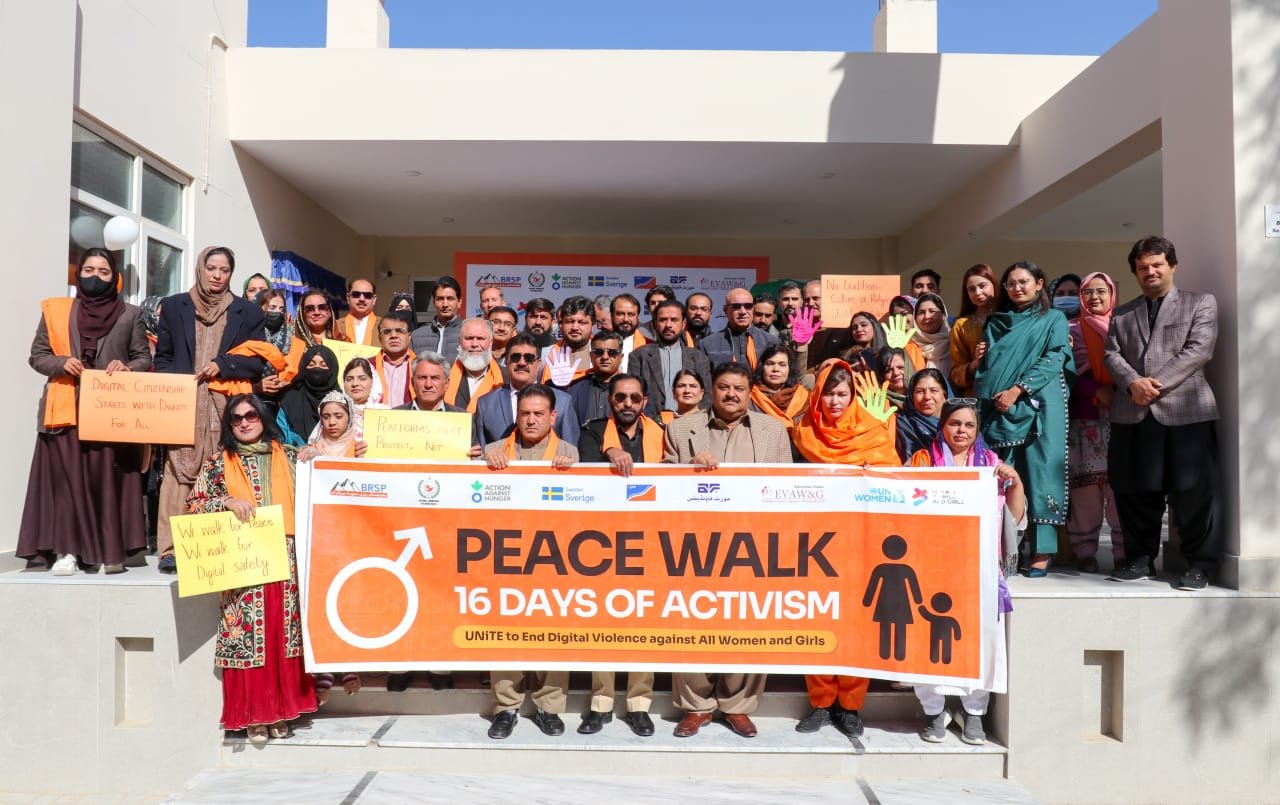
Balochistan, like the rest of Pakistan and the world, has launched the annual 16 Days of Activism Against Gender-Based Violence, a global campaign observed from 25 November to 10 December aimed at raising awareness, strengthening protections, and promoting the rights of women and girls.
This year’s provincial launch event—organized with the support of EVAWG Alliance, National Commission for Human Rights, Aurat Foundation, UN Women, BRSP, Action Against Hunger, Taraqee Foundation, and other partners—focused on the theme:
“Ending Digital Violence Against All Women and Girls—Join the Movement to Combat Online Abuse.”
A Call for Collective Action
Senior government officials and civil society representatives attended the event, including Additional IG Police (Gender) Israr Ahmed Umrani, Director Headquarters Social Welfare Department Ashraf Gichki, Deputy Secretary Women Development Department Jehan Ara Tabassum, Director PDMA Naveed Ahmed, UN Women’s Ayesha Wadood, former Chairperson of the Balochistan Commission on the Status of Women (BCSW) Fauzia Shaheen, and representatives from BRSP, AAH, Taraqee Foundation, NCHR, and other organizations.
Opening the session, Aurat Foundation’s Regional Director and EWAAG Alliance Chairperson, Alauddin Khilji, highlighted the global significance of the campaign, noting that it aims not only to raise awareness but also to promote concerted actions that help address long-standing inequalities and structural barriers affecting women in Pakistan and especially Balochistan.
Digital Violence: An Emerging Threat
UN Women’s Ayesha Wadood drew attention to the alarming rise in gender-based violence nationwide. She emphasized that digital violence is now one of the most pervasive forms of abuse, with 57% of women globally experiencing some form of online harassment.
“Digital violence is not just an emerging issue—it is a deeply serious threat,” she said, adding that artificial intelligence is further intensifying risks by enabling new forms of online manipulation and exploitation. She stressed the need for the government to strengthen legal implementation, address capacity gaps, and adopt a holistic policy response.
Challenges in Health, Education, and Protection
Social Welfare Department’s Ashraf Gichki highlighted ongoing hurdles faced by women in Balochistan—particularly in healthcare, education, safety, and access to justice. He emphasized coordinated efforts and the crucial role of media, academic institutions, and religious leaders in transforming social attitudes that perpetuate discrimination and violence.
Legal Frameworks and the Road Ahead
Former BCSW Chairperson Fauzia Shaheen recalled the passage of the 2016 Domestic Violence Act by the Balochistan Assembly, stressing the need to strengthen protection committees, increase awareness campaigns, and expand services for survivors. She welcomed recent progress, including the formulation of rules under the Child Restraint Act and Disability Law, and assured that Safe Homes for women and girls in distress will be operational soon.
Shaheen further emphasized the importance of supporting young women facing online harassment. “Girls affected by digital violence must be encouraged to report cases, and families must stand behind them so they do not suffer in silence,” she said.
A Collective Journey Toward Equality
Speakers unanimously stressed that gender-based violence remains one of the most pervasive human rights violations, demanding stronger institutional responses, community engagement, and legal enforcement. From combating online abuse to ensuring safer public and digital spaces, the 16 Days campaign serves as a reminder that ending violence is a shared responsibility.
As Balochistan embarks on another year of activism, the message is clear:
Empowerment, protection, and equality for women and girls must remain at the heart of social progress.
16 Days of Activism Against GBV Kicks Off in Balochistan