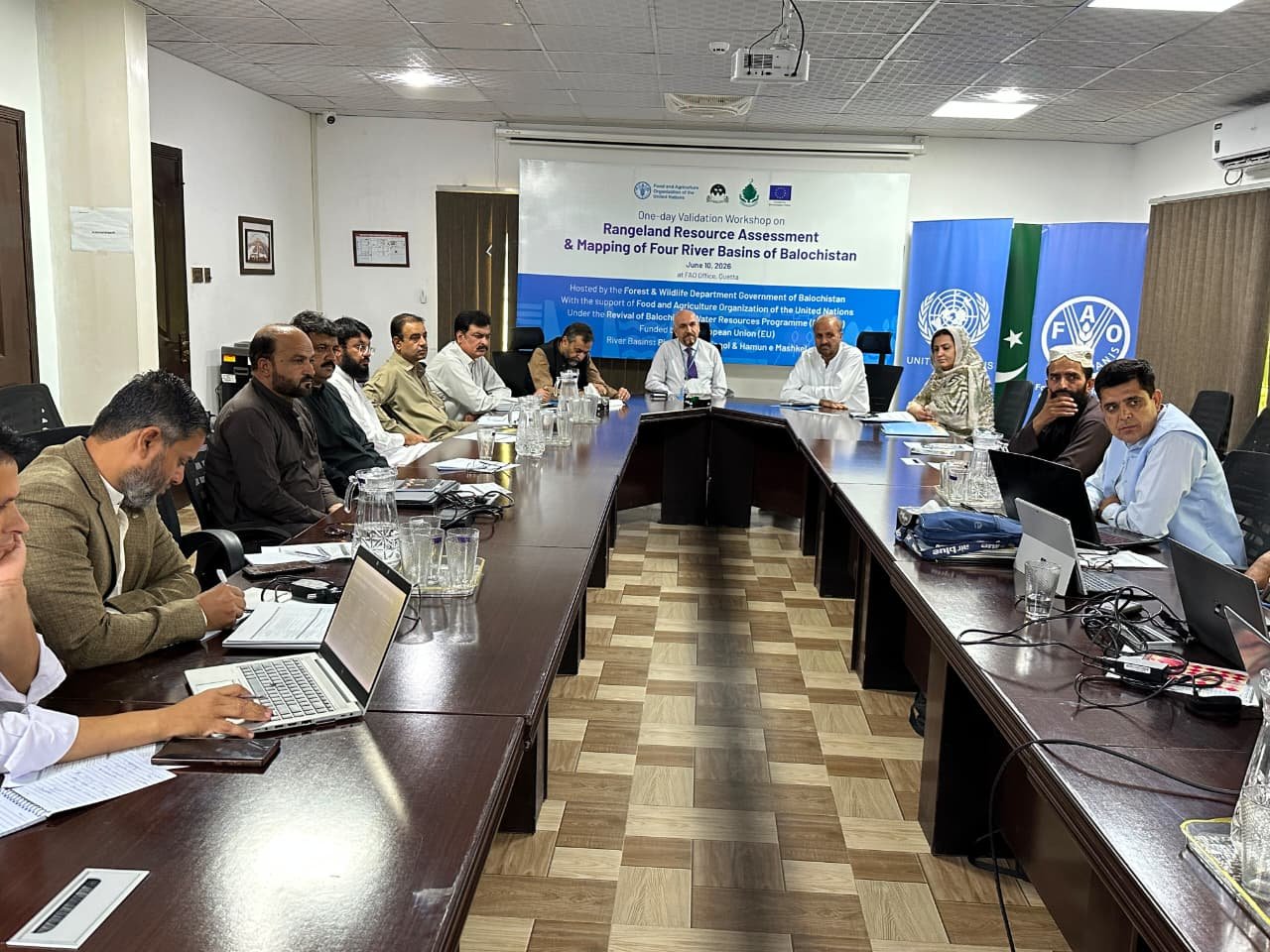
QUETTA: A validation workshop on the Rangeland Resources Assessment and Mapping (RRAM) of four selected river basins in Balochistan was held here on Wednesday under the European Union-funded Revival of Balochistan Water Resources Programme (RBWRP), implemented by the Food and Agriculture Organisation (FAO) in collaboration with the provincial Forest & Wildlife Department.
Held at the FAO office in Chaman Housing Scheme, the workshop brought together senior officials, conservation experts, researchers and technical specialists to review and validate findings of the rangeland survey conducted across major river basins of the province.
The session opened with recitation from the Holy Quran followed by a welcome address by Mr Jafar Ali Baloch, who outlined the objectives of the workshop. Dr Muhammad Essa Jan of FAO briefed participants on the significance of the exercise for sustainable rangeland management and evidence-based planning.
In his opening remarks, FAO Balochistan Head of Office and Programme Coordinator Waleed Mahdi stressed the importance of scientific assessment and mapping of rangeland resources to support long-term natural resource planning and climate resilience in the province.
Chief Conservator of Forests, Forest & Wildlife Department, Syed Ali Imran, highlighted the role of rangelands in supporting biodiversity, livestock livelihoods and rural economies, calling for integrated approaches to restore degraded ecosystems.
Technical sessions included presentations on methodology and basin-wise findings. Dr Faizul Bari outlined the purpose of comprehensive rangeland assessments, while Mr Jafar Ali Baloch presented the overall survey approach and key findings.
Deputy Conservator Dr Muhammad Imran shared results from the Pishin-Lora River Basin, Mr Muhammad Saeed presented findings from the Nari Basin, Mr Ghulam Sarwar briefed participants on the Hamun-e-Mashkil Basin, while Mr Naeem Javed presented the assessment of the Hingol River Basin.
The presentations highlighted vegetation conditions, grazing pressures, land degradation trends and restoration opportunities across the surveyed areas, followed by an interactive discussion and technical feedback session.
In the concluding remarks, Chief Conservators of Forests (North and South) and Secretary Forest & Wildlife Department, Imran Gichki, appreciated the joint efforts of FAO and the provincial department, noting that the validated findings would support policy formulation, watershed management, biodiversity conservation and climate resilience initiatives.
Participants reaffirmed commitment to sustainable rangeland management, while FAO officials thanked stakeholders for their contributions and support.
The workshop concluded with a vote of thanks, group photograph and luncheon.